
Sports Mindset Coaching
“Performance is never only physical!”
Resilience, focus and growth in performance
Athletic development depends just as much on mindset, emotional stability, resilience, confidence, self-awareness, and the ability to deal with pressure, setbacks, expectations, and change.
Sports Mindset & Talent Development supports athletes, coaches, and teams in strengthening exactly these capacities — always with the understanding that sustainable performance grows best when human development is taken seriously.
Because behind every performance there is always a person.
And behind every athlete there is a story, a context, and often an emotional reality that deserves attention.
A Perspective Shaped by Experience
This work is led by Erich Schimmel, certified Sport Psychologist trained through Barça Innovation Hub.
His own sporting journey strongly shapes the philosophy behind this work.
As a young athlete, Erich experienced how quickly sporting dreams can be interrupted. At the age of 18, a serious back injury forced him out of sport for several months, accompanied by the message that competitive sport might no longer be possible.
For a young athlete, this kind of moment reaches far beyond the physical.
It touches identity, confidence, motivation, and the relationship to one's own future.
What followed was not simply recovery, but a new relationship with sport: one less defined by external expectation and more deeply rooted in joy, resilience, and meaning.
That experience remains central today — also in watching his own daughter pursue ambitious sporting goals and navigate the emotional realities that belong to athletic development.
Because every athlete eventually encounters moments where results, pressure, doubts, and self-belief meet.
Coaching at the Heart of Performance
Alongside personal experience, this work is informed by years of supporting athletes and coaches in demanding performance environments, including Feldhockey Bundesliga.
This includes work with:
- confidence under pressure
- emotional regulation before competition
- performance after mistakes
- communication with coaches
- handling expectations
- maintaining joy in sport
- navigating setbacks and difficult phases
The goal is not simply performance enhancement.
The goal is helping athletes perform well without losing themselves in the process.
The Emotional Reality of Athletes
Athletes often carry much more than is visible from the outside.
Training, competition, school or university, expectations from family, social comparison, selection pressure, injuries, team dynamics, and self-expectation all interact constantly.
This is why coaching does not only focus on performance behaviour, but on the athlete as a whole system.
Because an athlete is never only an athlete.
Every athlete is influenced by:
- family dynamics
- friendships
- academic pressure
- identity development
- emotional well-being
- personal expectations
- and many other factors
Understanding these connections often creates the real breakthrough.
The Phase Model by Erich Schimmel
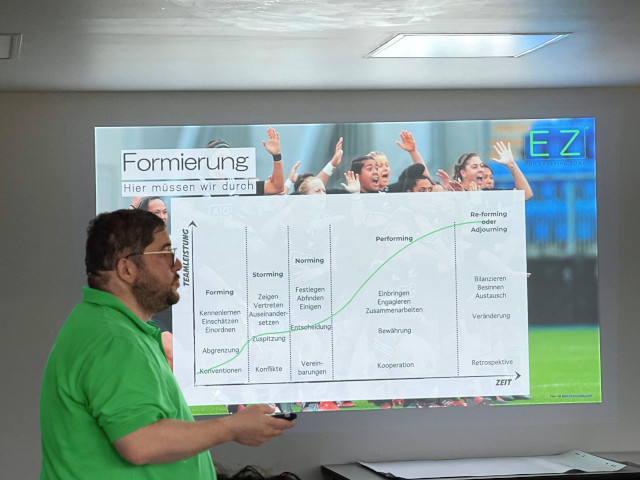
Athletic development rarely follows a straight line.
Periods of confidence, rapid progress, stagnation, frustration, doubt, and renewed growth belong naturally to every sporting journey.
This is where the Phase Model developed by Erich Schimmel often provides valuable orientation.
The model helps athletes and coaches understand that difficult periods are often not signs of failure, but natural phases of development.
Recognising the phase often reduces pressure and allows more constructive action.
This is especially important when athletes experience:
- loss of confidence
- unexpected setbacks
- selection disappointment
- injury phases
- emotional overload
- motivational fluctuations
Because once a phase becomes visible, it often becomes easier to move through it.
Working with Athletes
Typical coaching topics include:
- confidence under pressure
- dealing with mistakes and setbacks
- focus and concentration
- balancing school and sport
- goal setting and action planning
- motivation and volition
- re-entry after injury or interruption
- emotional resilience
- communication with coaches, parents, and teammates
- dealing with expectations
Mental training methods are integrated where useful, including:
- Visualization
- Mental rehearsal of successful performance situations.
- Positive Self-Talk
- Strengthening constructive internal dialogue.
- Mindfulness and Relaxation
- Improving focus and reducing pressure.
- Goal Setting
- Building realistic and motivating pathways.
- Resilience Training
- Developing practical strategies for difficult moments.
Working with Coaches
Coaches influence far more than performance.
They shape learning conditions, emotional climate, trust, motivation, and development.
Coaching for sports coaches can include:
- creating conditions for learning
- communication with athletes
- balancing challenge and support
- strengthening resilience in athletes
- objective setting
- feedback culture
- reintegration after absence or injury
- maintaining motivation across difficult phases
Because coaching is never static.
The role evolves with each athlete, each team, and each developmental phase.
Team Development
Strong teams do not emerge automatically.
They require conscious work on:
- trust
- communication
- role clarity
- collective resilience
- feedback culture
- shared objectives
- team reflexion
- lessons learned
Team development helps teams not only improve performance, but also strengthen cohesion and emotional stability.
Because collective atmosphere often influences performance more than people realise.
Starting the Process
How do we cooperate?
For younger athletes, coaching only begins when the athlete genuinely wishes to engage.
Where appropriate, parents are included as supportive partners.
Two introductory 30-minute sessions are offered free of charge and can be shared between parents and athlete.
For older athletes, parental involvement remains possible but is not required. If parental involvement is not wished, only a 30-minute exploring session is offered free of charge.
First Step
Sometimes one conversation creates relief.
Sometimes it creates a new perspective.
Sometimes it helps an athlete or coach reconnect with why they started.
That often changes more than expected.